Showing posts with label capitalism. Show all posts

Saturday, December 18, 2010

You're not sick, you're a capitalist

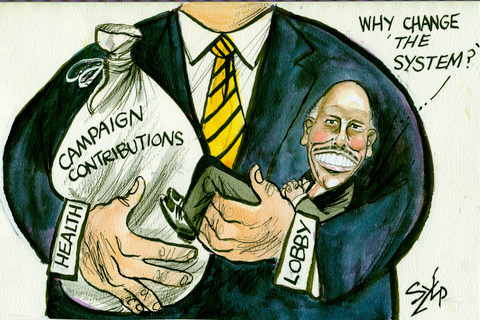
image source: DS Comic
This CNN piece just confirms what many of us already know. Over-medication is a serious health issue. Unscrupulous drug manufacturers (also known as "Big Pharma")[1] are making up diseases and then using slick marketing techniques to compel you to buy the drugs they have concocted to "treat" the bogus disease,[2] which only leads to more ill-health. 

Another variation of over-medication is what I call "dumping." Dumping consists of exploiting vulnerable people, say elders on Medicaid. The doctor or several doctors (Medicaid patients often get bounced around to different doctors) will simply prescribe far more drugs than a patient needs.

I have experienced "dumping" first hand. Several years ago I discovered that an elder neighbor had accumulated something like 36 bottles of drugs--17 different prescriptions. The details are fuzzy now but I am pretty sure he was taking all or most of the prescriptions. If I recall correctly, I was able to get the doctor to reduce the meds to 8, (4 for blood pressure). But all of this is just scratching the surface--just a few of the many examples of how capitalism-run-amok is killing us. 

Oh, and a missing piece to the CNN story is the collusion of medical doctors. [3][4] GI

How to brand a disease -- and sell a cure - CNN.com

Quoting from CNN:
Just as Bernays sold pianos by selling the music room, pharmaceutical marketers now sell drugs by selling the diseases that they treat. The buzzword is "disease branding."

read essay @ How to brand a disease -- and sell a cure - CNN.com


[1] The Fear of Sicko (Democracy Now featuring Michael Moore)
[2] The Disease Mongering Machine
[3] Harvard Medical School in Ethics Quandary
[4] Brooklyn Arrests Are Part of "Largest Medicare Fraud Bust Ever"


Also dig:

tags: health, health care, elijah muhammad, nation of islam, how to eat to live, conspiracy, capitalism


Thursday, July 8, 2010

Nigerian Businessman, Adebayo Ogunlesi, Buys Gatwick Airport in London

This story called to mind Muhammad Ali marveling at the fact that the last leg of his flight to Congo was with black pilots.


"He was thrilled," Dundee said. "And happy. He said, "Come here, Angelo, and go to where the pilots are.
That's my people - they're flying the plane.' He spent the whole flight going back and forth between his seat and the cockpit."


I wonder what Ali would say about an African-owned airport [update: a commentator has pointed that Mr. Ogunlesi is a major partner in a company that now owns Gatwick. It is, therefore, imprecise to say "Africa-owned." GI] in London? But I also wonder if black capitalism solves any of the pressing problems of the global African community?


Click on video below or here. 


Tags: Nigeria, London, capitalism 

Tuesday, April 6, 2010

Garvey's Ghost: Bi-racial genocide in Congo (DRC)?

Yet another layer to the ongoing brutal exploitation of the Congelese nation. Horrifying testimonies alleging the systematic murder of bi-racial babies by Japanese miners in Katanga, DRC.


Watch video of bi-racial genocide @ Garvey's Ghost: Black Talk

tags: congo, japan, corporatocracy, capitalism, development,

Monday, March 22, 2010

Lobbyists Swarm Capitol To Influence Health Reform

There is no democracy here. You gotta pay to play. GI

Dig it! 


By Joe Eaton and M.B. Pell | February 23, 2010


A Center for Public Integrity analysis of Senate lobbying disclosure forms shows that more than 1,750 companies and organizations hired about 4,525 lobbyists — eight for each member of Congress — to influence health reform bills in 2009.
The list of companies and organizations that worked to put their imprint on legislation is diverse, ranging from health care interests and advocacy groups to giant corporations, small businesses, American Indian tribes, religious groups, and universities.
Among industries, 207 hospitals lined up to lobby, followed by 105 insurance companies and 85 manufacturing companies. Trade, advocacy, and professional organizations trumped them all with 745 registered groups that lobbied on health reform bills, illustrating the common Washington strategy of special interests banding together to pool money and increase their influence.

tags: capitalism, corporatocracy, health care, lobbyist

[photo:source]

Saturday, March 20, 2010

Genetically modified Ghana

Posted by the ghetto intellectual on 3/20/2010

Dig it!


I have made a new friend from Lesotho who recently arrived in the USA for a certificate program. Besides joking with me that my voice "does not sound right" (she thinks I sound white. a devastating charge for a ghetto intellectual. LOL!), she sometimes complains that American food does not taste natural. Well, if Monsanto and friends have their way those unnatural genetically altered foods will increasingly find their way to Lesotho and other African destinations. GI


Source: Salon


A voice of caution on GMOs from the Vatican challenges biotech inroads into sub-Saharan Africa


BY ANDREW LEONARD

The Catholic News Service reported last week that the Vatican might havesignaled a change in policy on genetically modified organisms by appointing Cardinal Peter Turkson as the head of the Pontifical Council for Justice and Peace.


Cardinal Peter Turkson told Catholic News Service March 9 that he would urge an attitude of caution and further study of the possible negative effects of genetically engineered organisms.

Under Cardinal Turkson's predecessor, Cardinal Renato Martino, the justice and peace council sponsored several conferences on genetically modified food as a way to alleviate hunger in poor countries.

Agribusinesses and biotech industries that produce genetically modified organisms are justified in wanting to recoup the expenses laid out for research and development, and they have a right to want to make a profit from their work, said Cardinal Turkson, who took over the reins of the council in January.
But the issue becomes problematic when a company that controls the use of genetically modified seeds and crops is motivated more by profit than by "the declared desire to want to help feed humanity," he said.


Cardinal Turkson is no dope (according to his Wikipedia bio he "is able to speak English, Fante, French, Italian, German, and Hebrew, in addition to understanding Latin and Greek.") Here he seizes upon the crucial point. Every time HTWW covers the issue of genetically modified organisms, some readers immediately accuse me of anti-science bias. But I don't actually have a position on whether GMOs are by definition good or bad for the environment or human health or even the challenge of alleviating hunger in the developing world. My basic stance, in fact, is pro-science: I believe technological advances have greatly advanced human health and affluence, and will continue to do so, if properly regulated. My concern re GMOs hasalways stemmed from a profound skepticism that profit-seeking corporations can be trusted to responsibly serve the public good. One need look only at the constant stream of reports detailing unethical and criminal behavior by major pharmaceutical companies to realize that this is hardly a hypothetical concern.
In the case of GMOs we are dealing with a remarkable concentration of intellectual property ownership in just a handful of corporations. Like all well-endowed corporate actors, these companies do not shy from vigorously lobbying governments in favor of putting into place place legal frameworks that are designed to maximize profits and minimize caution.
Cardinal Turkson is from Ghana, where this process is exquisitely visible. Most African countries are signatories to the Cartagena Biosafety Protocol,which calls for national biosafety laws to include something called the"precautionary principle." The precautionary principle puts the burden of proof on those who favor taking a specific action, (such as introducing genetically modified cassava plants into Ghana) rather than on those who resist that action. In other words, a biotech company would have to prove its product was safe, rather than Ghana prove it was unsafe. For understandable reasons, the likes of Monsanto and Syngenta hate the precautionary principle, and are doing everything within their power to ensure that national biosafety laws avoid any mention of such a horror.
If you google Ghana and genetically modified crops, you will very quickly run into the name Walter Alhassan, a consultant for the Accra-based Forum for Agricultural Research in Africa (FARA), and a strong advocate for the position that Ghana's government "needs to speed up the passage of the Biosafety Bill to the global trend to improve agriculture and food security."
<><><><><><><>

From AllAfrica.com:


Prof. Alhassan however brushes aside the fears expressed against GM crops. "GM crops are safer than non-GM crops because they go through stringent measures. Those who have expressed misgivings about it are only doing so because of fears of the unknown."

He admits that GM technology could be misused. "It is possible that someone can move one gene from one crop to another to cause problems. But that is why regulatory bodies are set up to ensure that the technology is properly guarded."


But who sets up the regulatory bodies? Tracing a connection between Alhassan and the GMO industry is child's play. Last November, the South African-based Center for African Biosafety documented some concerns about how African biosafety laws were being shaped by foreign biotech concerns. Alhassan's employer, FARA, noted the report's author, Haidee Swanby, was a major player in prepping the region for "the safe deployment of modern biotechnology."


 In May 2009 the Syngenta Foundation for Sustainable Agriculture (SFSA) and FARA announced their partnership to launch a 3 year project for capacity building in biosafety in sub-Saharan Africa. The Project on Capacity Strengthening for the Safe Management of Biotechnology in Sub-Sahara Africa will be implemented by the Sub-Regional Organisations and the National Agricultural Research System in six countries in sub-Saharan Africa: Burkina Faso, Ghana, Nigeria, Kenya, Uganda and Malawi. FARA will manage the $1,265,565 project under the leadership of Professor Walter Alhassan. 


Let's be clear here: Syngenta's motivation in strengthening the capacity of sub-Saharan Africa to safely manage the introduction of genetically modified crops is not motivated by a corporate desire to end hunger. Perhaps some Syngenta scientists are energized by such a goal, but the private-sector funding of FARA is authorized under the expectation that it will help carve out new markets for Syngenta products. In the face of such pressure, caution is always warranted.


See also:
• Is Monsanto the answer or the problem? 
• Monsanto: Africa's Johnny Seed?
• The principles of food sovereignty.
• Biofuel farming threatens food security.
• Get your farm on. Food Inc. is killing us softly.


Cartoon: Source


Tags: agriculture, corporatocracy, capitalism
Enhanced by Zemanta

Thursday, November 12, 2009

Harvard Law School Conference Impact of International Trade Policies of Economic Development in the Middle East: Speakers David Harvey and Safwan Masri

Harvard  University
HARVARD LAW SCHOOL
The Harvard Arab Alumni Association and the Harvard Law School Middle East Law Students Association Present:
Harvard Law School Conference

Impact of International Trade Policies of Economic Development in the Middle East
Friday, November 13, 14:00-16:00
Registration to begin at 13:30 and refreshments to follow panel discussion.
HARVARD LAW SCHOOL | Austin North
For further information, please email info@harvardarabalumni.org
Speakers
David Harvey:  Professor, CUNY
Safwan Masri:  Professor, Columbia University


tags: capitalism, david harvey, harvard, Marxism

Monday, October 5, 2009

End of Poverty? (H/T Tiffany)

Dig it.


I know a little sumthin' about this topic. My mom worked long hours, but we were poor by American standards. We received welfare: Section 8, food stamps, government cheese, you name it. And I have worked for a Welfare to Work program (a racist policy enacted by Bill Clinton and calculated to win back anti-black democrats who have been fleeing the democratic party since the Civil Rights movement). Call me biased, but it is pretty clear to me that poverty is less about lazy people who don't want to work and more about a deeply flawed economic system that doles out trillion dollar bailouts (H/T Nikitah) and encourages greed and ruthless competition among corporate elites...

This looks to be a good follow-up to Michael Moore's Capitalism: A Love Story. The documentary is called End of Poverty? It debuts 13 November in New York and 25 November in Los Angeles...


We can end poverty. We can, we must.GI